Menopause and Nail Changes: Why It Happens and What Actually Helps
Nails change at the menopause, and the reasons are less well documented than you might expect. Here our nail expert Lynn Mason sets out what she sees, why it happens, and the twelve-week routine she recommends for it. We have checked her advice against the NHS, the British Skin Foundation, DermNet and published dermatology research, and we say plainly where the evidence is strong and where it is thinner. The short answer: nails can genuinely become drier, more brittle and slower-growing around this stage of life, largely for the same reason skin does, falling oestrogen affects hydration and the proteins that give tissue its structure. But much of what women notice at this age is normal nail ageing that would be happening anyway, and telling the two apart matters.

summary
Does the menopause affect your nails?
It can, though the evidence is less direct than you might expect. The NHS's own list of menopause and perimenopause symptoms includes hair thinning and "skin changes, including dry and itchy skin" (it does not list nail changes as a named symptom). That does not mean nails are unaffected. Nails are made of keratin, the same structural protein as hair and the outer layer of skin, and the British Skin Foundation has well documented how falling oestrogen reduces skin's ability to hold water and weakens its barrier. It is biologically plausible that similar hormonal shifts can affect the nail plate and the nail matrix (the tissue under the cuticle where new nail is made), since nails and skin share the same keratin biology and the same hormonal environment. But there is not the same body of published research on nails specifically as there is on skin, so treat "the menopause is why my nails changed" as a reasonable working explanation rather than a proven one. In practice, most women who notice nail changes in their late forties or fifties are likely to be dealing with a mixture of two things at once: ordinary age-related nail changes, and whatever the menopause may be adding on top.
What is actually well evidenced, and what is not
It helps to separate what is solidly established from what is extrapolated. Well evidenced: nails do become more brittle, thicker or slower-growing with age generally, this is documented in dermatology literature independent of the menopause. Well evidenced: skin's collagen and hydration decline sharply as oestrogen falls, this is specifically studied and quantified. Well evidenced: nails grow at around 3mm a month on average, so a full nail change usually takes several months, not days. Weaker or extrapolated: the claim that falling oestrogen might directly weaken nail keratin the way it affects skin collagen. This is a plausible mechanism, given nails and skin share the same protein biology, but it has not been studied and quantified for nails the way it has for skin. No UK clinical body currently lists nail changes as a defined menopause symptom.
Menopause or just ageing? How to tell the difference
Nails naturally change with age in everyone, regardless of hormones. The NHS notes that nails commonly "become thicker or break more easily (brittle) as you get older." Dermatology research on nail ageing suggests nail growth rate can slow by around 0.5% a year from your mid-twenties onwards, with an average slowdown of roughly 38% between your thirties and your eighties, alongside more visible ridging and a duller, sometimes yellower colour. So if you are in your late forties, fifties or sixties and your nails are more brittle or ridged than they used to be, some of that is simply the passage of time and would be happening whether or not you were going through the menopause. What may be specific to this life stage is the timing: if brittleness, dryness or slow growth appears or worsens noticeably around the time of the menopause (which the NHS says usually affects women between 45 and 55), it is reasonable to consider hormones as a contributing factor alongside normal ageing, general hydration, nutrition and how hard your hands work day to day.
What are the signs to look out for?
The changes women most often describe at this stage can include peeling and splitting layers at the nail tip (onychoschizia), softness or a nail that bends rather than holds its shape, fine longitudinal ridges running from cuticle to tip, general dryness of the nail plate and surrounding skin, slower visible growth, and dry, sometimes sore cuticles. These are all recognised, named nail changes in dermatology, onychoschizia (lamellar splitting) and onychorrhexis (ridging) are standard terms, not marketing language, and ageing is described in the literature as "the commonest cause" of the ridging pattern. None of them are unique to the menopause on their own; what makes them worth paying attention to at this age is if several appear together and represent a real change from how your nails used to be, rather than how they have always been.
How long does it take to see a difference?
Longer than most people expect, and that is worth saying plainly rather than promising a quick fix. A fingernail grows at an average of around 3.5mm a month, so a nail that is damaged or affected right at the cuticle takes roughly three to six months to grow out completely. Nothing you apply to the outside of the nail changes the nail that is already there, because visible nail is dead tissue, what a good routine actually does is protect and support the new nail as it grows from the matrix, and reduce the everyday damage (water, detergents, harsh removers, knocks) that makes the existing nail worse in the meantime. Plan in months, not days, and judge a routine over at least one full growth cycle before deciding whether it is working.
Our twelve-week nail programme for the menopause
There is no menopause-specific nail treatment, and no cosmetic product can alter hormone levels. What a routine can do is work with the nail's own growth cycle. A nail takes roughly three to six months to grow out completely, so twelve weeks covers a good part of a full cycle, long enough to judge the routine on genuinely new nail rather than on the nail you already had when you started. That is why we set this out as a twelve-week programme rather than a quick fix. It has a daily part and a weekly part, and consistency matters more than any single step.
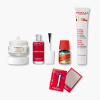
Every day. Mava-Strong Base, our base coat for weak nails, worn under colour or on its own. Every evening, Nailactan, our nourishing cream built around amino acids, lipids and strengthening vitamins, applied to the base of the nails and massaged in with your thumb in circular motions. It works on the nail root even through polish, though bare nails at least once a week gets the most from it. Nailactan contains vitamin A, so take your overall daily intake into account before you start using it nightly. Mavapen goes around each nail for the cuticles, and its felt tip works over polish, so it lives in a handbag.
Two to three times a week. Scientifique K+, our keratin hardener, brushed from the centre of the nail towards the tip, avoiding the cuticles. Its formula is built on dimethylurea, which we formulate to improve the cohesion of the nail's keratin fibres, and it contains no formaldehyde, a genuine point of difference given EU cosmetics rules prohibit free formaldehyde and restrict formaldehyde-releasing hardeners in nail products.
Once or twice a week. Lightening Nail Scrub, after removing polish. A small amount on each nail and cuticle, massaged for ten to twenty seconds, then rinsed with warm water and dried thoroughly. Leave this step out if your cuticles are inflamed or sore.
At the Health & Wellbeing Awards 2026, Nailactan took Silver and Mava-Strong Base Coat took Bronze in the Nail Product of the Year category.
Alongside all of it, protect. Gloves for washing up and cleaning, and a gentle non-acetone remover rather than a harsh one. The everyday damage that makes any nail worse affects nails at this stage just as much, often more if they are already starting from a drier baseline.
None of this reverses hormonal change or regrows a nail overnight. What it does is support the nail that is currently growing and cut down the damage that makes brittleness worse. Full detail on the underlying protect, harden and nourish method is in our companion guides, Brittle Nails: Causes & How to Strengthen Them and How to Strengthen Weak Nails. If skin as well as nails has changed, our guide to menopause and your skin covers that side.
Can diet or supplements help?
General good nutrition supports nail health the way it supports the rest of the body, adequate protein, iron and a varied diet, but there is no good evidence that any specific supplement reverses menopause-related nail changes. If you are worried you might be low in iron or another nutrient (tiredness, pale nails, and other symptoms alongside brittle nails can sometimes point that way), that is worth raising with your GP, who can test for it rather than guessing with a supplement aisle.
When to see a GP or dermatologist instead of buying a product
Most of what is described above is cosmetic and gradual, and a sensible routine plus patience is the right response. Some changes are not, and need a doctor rather than a nail product. The NHS advises seeing your GP if a nail has changed shape, colour, or fallen off and you do not know why, or if the skin around a nail has become sore, red, swollen and warm, which can signal infection. Specifically worth flagging urgently: a sudden change affecting only one nail rather than several (general menopause-related change tends to affect nails fairly evenly, a single outlier nail points to something else, such as injury, fungal infection or, rarely, something more serious), the nail lifting or separating from the nail bed, a new dark line or streak running down the nail that does not grow out or fade, pain, swelling or discharge around the nail, or signs that suggest a fungal infection (thickening, yellowing, crumbling, usually starting at one edge). None of these are something a nail hardener or oil will fix, and treating them as a cosmetic problem risks delaying the right diagnosis.
Does the menopause cause brittle nails?
It may contribute, though the direct evidence for nails is weaker than for skin. Nails and skin share the same keratin biology, and falling oestrogen is well documented to reduce skin's hydration and collagen. It is plausible this affects nails too, but no major UK health body currently lists nail changes as a defined menopause symptom the way it lists skin and hair changes, so treat it as a likely contributing factor rather than an established fact.
Is it the menopause or just my age?
Often both. Nails naturally become more brittle, thicker and slower-growing with age in everyone, this is well documented independently of the menopause. If the change coincided with perimenopause or menopause, hormones may be an added factor, but ordinary ageing is likely doing most of the work regardless.
How long does it take for nails to grow back healthy?
A fingernail grows at roughly 3.5mm a month on average, so a full nail typically takes three to six months to grow out from cuticle to tip. Because visible nail is dead tissue, existing damage cannot be reversed, only protected while new nail grows in. Judge any routine over a full growth cycle, not days or weeks.
What is the best nail routine for menopausal nails?
We recommend a twelve-week programme, because that is long enough to judge it on new nail rather than on the nail you started with. Daily: Mava-Strong Base as a base coat, Nailactan massaged into the base of the nails each evening, and Mavapen around the cuticles. Two to three times a week: Scientifique K+, our keratin hardener, from the centre of the nail towards the tip, avoiding the cuticles. Once or twice a week: Lightening Nail Scrub after removing polish. Throughout, protect nails from water and detergents with gloves for wet work and a gentle remover. There is no separate "menopause nail treatment", the goal is reducing everyday damage and supporting healthy new growth.
When should I see a doctor about my nails rather than treating them at home?
See a GP if only one nail is affected rather than several, if a nail is lifting or separating from the nail bed, if you notice a new dark line or streak that does not grow out, if there is pain, swelling or discharge, or if you suspect a fungal infection. The NHS also advises seeing a GP for any unexplained change in nail shape, colour or thickness. These need medical assessment, not a nail product.
Can a nail hardener fix menopause-related nail changes?
No product can alter hormone levels or reverse the underlying change. A keratin hardener such as Scientifique K+ can reinforce the existing nail so it splits and breaks less while it grows, and a nourishing treatment can help keep the nail and cuticle more comfortable. That is cosmetic support during the growth cycle, not a cure.
About Mavala UK
Mavala is a Swiss, family-owned nail and beauty house, founded in Geneva in 1959 by Madeleine Van Landeghem. Her first product was Scientifique, a nail hardener she created to solve her own nail problems, and it remains one of our best known. Our nail care is formulated in Switzerland. Lynn Mason is our nail expert and the author of the routine set out above. Our nail treatments are designed to protect nails from everyday damage and support them while they grow, not to alter the hormonal changes of the menopause, which is a matter for a GP or menopause specialist, not a cosmetic brand. Our sources are listed in full below.
Sources
- NHS, "Nail problems": age-related brittleness and the red-flag symptoms that need a GP (accessed 5 August 2026).
- NHS, "Menopause and perimenopause": the menopause usually affects women between 45 and 55 (accessed 5 August 2026).
- NHS, "Symptoms of menopause and perimenopause": confirms nail changes are not a listed NHS menopause symptom, while hair thinning and skin changes are (accessed 5 August 2026).
- British Skin Foundation, "The impact of the menopause on your skin": oestrogen's role in skin hydration and barrier function (accessed 5 August 2026).
- DermNet, "Nail terminology": definitions of onychoschizia (lamellar splitting) and onychorrhexis (longitudinal ridging) (accessed 5 August 2026).
- Yaemsiri S, Hou N, Slining MM, He K, "Growth rate of human fingernails and toenails in healthy American young adults", Journal of the European Academy of Dermatology and Venereology, 2010. Average fingernail growth 3.47mm a month.
- Singh G, Haneef NS, Uday A, "Nail changes and disorders among the elderly", Indian Journal of Dermatology, Venereology and Leprology, 2005. Age-related growth-rate slowdown, ridging and colour change with normal ageing, independent of the menopause.