Nails After Gel or Acrylics: How to Get Them Back
If gel or acrylics have left your nails weak, you cannot repair the nail you can see; you protect it while a healthy nail grows through. Reinforce the tips with Mavala Scientifique K+ once or twice a week, nourish the base every evening with Nailactan, keep nails short, wear gloves for wet work, and skip another set for now. A fingernail is replaced in up to six months. In this guide, Mavala UK's nail expert Lynn Mason sets out that routine week by week, alongside what the British Association of Dermatologists says about artificial nails and what the NHS says about nail regrowth. It builds on the one question about gel damage in our guide to strengthening weak nails.
summary
What can gel and acrylics do to the nail?
The visible nail is already formed. Nothing you brush on can rebuild it, which is why any damage left by gel or acrylics has to grow out rather than be fixed in place.
Where damage happens, it can come from the cycle of application and removal, because removal can mean the nail is buffed, scraped or soaked. The British Association of Dermatologists says that acrylate-containing nails can also cause physical damage to the nails and cuticles when they are removed, either by buffing, scraping or acetone soaking. Its guidance on the three main systems is that gel nails cannot be removed by soaking and must be buffed off, while acrylic nails and gel polish are recommended to be removed by soaking in acetone. Our own Mavala guidance describes acetone as particularly drying and harsh, and says buffing can reduce nail thickness. Our French site adds that pulling a set off dry can take layers of nail with it.
So a nail that has just come out of gel or acrylics may be thinner, drier or tender at the surface. The routine below answers each of those.
One separate point. The same (meth)acrylate chemicals can cause a contact allergy. If you have an itchy rash rather than a weak nail, that is a question for a GP, not a nail product.
How do you take gel or acrylics off without damaging the nail?
If you are reading this with the set still on, the removal matters as much as anything that follows.
- Never peel, pick or pull them off. Our French site's advice is to let a set dissolve rather than lift it, and never to tear it away. Soak-off systems come off with a soak, ideally where they were applied. Hard gel cannot be soaked off, so it is best taken off by the technician who applied it.
- Oil before and after. Our French site recommends nourishing the nail generously with an oil before and after removal. Cuticle Oil is made for daily use on the nail contour, massaged in with your thumb, including the fingertips.
- If the surface is ridged or rough where the product came off, buff gently, only to smooth ridges, never to thin the nail, then Ridge Filler evens the surface under polish or on its own. A nail coming out of gel may have little thickness to spare.
- File with an emery board, not clippers. Our published method is to hold the board at 45 degrees under the free edge and move from the side to the centre only, which helps stop nails breaking at the side and splitting. Keep them short, but not too short. Our guide to filing without weakening the nail covers the grit and the shape.
How do you repair nails after gel or acrylics? The week-by-week routine
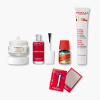
We recommend acting on three axes: protect, reinforce, moisturise. Everything below is one of those three, and every product in it is in our Nails After Gel or Acrylics collection.
Week 1: protect the nail and start the treatments
- Every evening: Nailactan at the base. Apply Nailactan, our nourishing cream for damaged nails, every evening to the base of the nails and massage in circular motions with your thumb. We describe it as enriched with essential amino acids, lipids and vitamins to nourish the root. Use daily for four to six weeks for best results; for severely damaged nails, continue for several months, because a nail takes about six months to regrow completely. It works on the nail root even with polish on, and on bare nails at least once a week. It contains vitamin A, so take your daily intake into account.
- Once or twice a week: Scientifique K+ on the tips. Mavala Scientifique K+, our keratin nail hardener for weak, soft and brittle nails, is designed to fortify the most delicate part of the nail, the tip. Clean the nails thoroughly, removing every trace of polish, then apply from the centre to the nail tips only, avoiding the cuticles. Keep your hands facing down and let it work for one minute. Lynn's advice is once or twice a week until your nails reach the strength you want, then reduce as needed. Avoid washing your hands straight after; the best time is the evening before bed, or as the first step of a manicure.
- Twice a week, if the nails feel dry and hard: Mava-Flex Serum. Nails that peel into layers after acetone may have lost moisture. Mava-Flex Serum, our moisturising serum for dry, hard and thickened nails, is made with a blend of urea, hyaluronic acid, calcium and vitamin B5, which we describe as restoring hydration and elasticity. Apply twice a week to clean, bare nails, brushing it over the whole nail surface, preferably in the evening so it can absorb overnight, and massage in with your thumb.
- If the nail is thin or sore to the touch: Nail Shield. Nail Shield, our two-phase protective barrier, guards the nail against shocks, splits and chips. We recommend it for nails with a damaged or thinned nail plate, or nails that are painful to the touch after artificial nail removal. Phase 1 is a protective mesh of nylon fibres applied to clean, oil-free nails; Phase 2 is our Ridge Filler, which smooths the surface. Finish with two thin coats of polish and a top coat, or a clear top coat for a natural look. It does not harden the nail; it protects it while the treatments above do their work, and we describe it as supporting recovery when combined with Scientifique K+, Mava-Flex or Nailactan.
- Fit the bare-nail steps around your manicure. Scientifique K+ and Mava-Flex need a bare nail, so do them on the evenings you take your polish or Nail Shield off with an acetone-free remover and redo your manicure, K+ first. On those evenings, follow the bare-nail treatment with Nailactan at the base, and leave it there: there is no need for oil afterwards, and an oily surface stops treatments like Scientifique K+ and Mava-Flex absorbing. Before Nail Shield or polish goes back on, clean the nails with a cotton pad soaked in nail polish remover so it adheres.
- Gloves. Wear gloves when washing dishes and house cleaning, to limit contact with water and detergents.
Weeks 2 to 6: keep going, and look after the cuticles
- Keep the same routine, with Nail Shield renewed as it wears.
- Cuticles every day, Cuticle Remover once a week. Removal can affect the cuticles as well as the nails, and the cuticle is the seal at the base of the nail, so keep it soft rather than cutting it. Cuticle Oil every day, ideally at night. Once a week, after a bath or shower when the skin is softer, use Cuticle Remover on polish-free nails: a generous layer around each nail, wait one minute, then gently push the cuticles back with a cotton-wrapped manicure stick, never a metal tool, and rinse thoroughly with soapy water. Do not use it on irritated, inflamed or chapped skin. Our cuticle remover guide goes into how often is too often.
- Wear colour if you like. Our published manicure is one thin coat of base coat, two thin coats of colour and one coat of top coat, renewed as soon as it starts wearing down and taken off with a gentle acetone-free remover. Which base suits a thin or ridged nail is covered in Base Coat, Ridge Filler or Nail Shield.
When your nails feel strong again: switch to maintenance
- Ease off the hardener, move to a strengthening base. Once your nails have reached the strength you want, reduce Scientifique K+ as needed. Many people use a focused hardener during an intensive rehab phase, then switch to a strengthening base as a maintenance product once their nails are back in good shape. Mava-Strong Base, our strengthening base for thin, soft and brittle nails, is designed for weak nails and protects them from the water and detergents that cause brittleness. Apply to clean nails at least twice a week, under polish or alone, and reduce the frequency once nails are strengthened. Keep Nailactan going for several months if the nails were severely damaged.
How long does nail recovery take after gel or acrylics?
Up to six months for a fingernail. The NHS says fingernails that fall off after an injury should grow back within 6 months, and toenails can take up to 18 months. In a published study of 22 healthy young adults, fingernails grew at an average of 3.47 mm a month and toenails at 1.62 mm a month (Yaemsiri et al., 2010). Any damage near the tip is filed away within weeks; damage near the base can take the full time. Plan in months, and judge progress by how the nail behaves, not how it looks.
How long should you wait before your next set?
Our French site recommends leaving at least two weeks between sets of semi-permanent polish, removal by soaking rather than pulling, and oil before and after. Its advice for nails coming out of artificial nails is to avoid semi-permanent polish for a few weeks. While your nails are still thin, our advice is a base coat and polish rather than another set, because semi-permanent systems need acetone to come off, and acetone can dry out a nail that may have little thickness to spare. Buff gently and rarely while nails are thin.
When should you see a GP about nail damage?
The NHS says to see a GP if a nail has changed shape, changed colour or fallen off and you do not know why, or if the skin around your nails has become sore, red, swollen and warm, which can be a sign of an infection. An itchy rash on the hands, eyelids, face or neck after a set of nails is a possible contact allergy, which is also a GP question.
How do you fix nails damaged by gel or acrylics?
You protect the nail and let a healthy one replace it: Mavala Scientifique K+ on the tips once or twice a week, Nailactan at the base every evening, Mava-Flex Serum if the nails are dry and peeling, and Nail Shield over a thin or sore surface. Keep nails short, wear gloves for wet work, and skip another set while the nail is thin.
How long do nails take to recover after gel or acrylics?
Up to six months for a fingernail to be fully replaced, which matches the NHS figure for a fingernail growing back after an injury. Any damage near the tip is filed away within weeks; damage near the base can take the full time.
Should you buff your nails after removing gel?
Only gently, and only to smooth ridges, never to thin the nail, because removal may already have taken some thickness off. If the surface is still uneven, a coat of Ridge Filler evens it without removing anything, and Nail Shield covers a thin or sore nail plate while it grows out.
What is the best nail treatment after acrylics?
There is no single product, because a nail after acrylics can be thin, dry and tender at once. Scientifique K+ reinforces the tip, Nailactan nourishes the root, Mava-Flex Serum restores moisture to a dry, hard nail, and Nail Shield protects a thin one while they work.
How long should you wait between gel manicures?
At least two weeks, which is our French site's advice, with the set soaked off rather than pulled and the nails oiled before and after. If your nails are already thin, wait until they have grown out and wear a base coat and polish in the meantime.
Why are my nails so thin after gel?
Because removal can take the top layers of the nail with it. The British Association of Dermatologists says acrylate-containing nails can physically damage the nails and cuticles when they are removed by buffing, scraping or acetone soaking, and gel in particular has to be buffed off. A thinned section cannot be thickened; it grows out, over up to six months for the whole nail, while Nail Shield protects it.
Can I wear normal nail polish after removing gel?
Yes. Our published manicure is one thin coat of a base coat, two thin coats of colour and one coat of top coat, renewed as soon as it starts to wear and removed with a gentle acetone-free remover. On a thin or sore nail, use Nail Shield as the base; otherwise a base coat rather than another set is what we advise while the nail grows out.
Lynn's view
“What I love about Mavala is that nail care is at the heart of everything we do. For me, it is helping people understand their nail issues and needs, and that is still a joy after all these years.” Lynn Mason, Mavala UK nail expert
About Lynn Mason, Mavala UK Nail Expert
Lynn Mason is Mavala UK's resident nail expert. She has worked with the Mavala brand for over a decade, training nail technicians and beauty editors across the UK and writing Mavala's how-to guides.
Mavala UK Online Store
Browse the Nails After Gel or Acrylics, Weak & Brittle Nails and Splitting and Peeling Nails collections, or the full Nail and Cuticle Care range
Sources
British Association of Dermatologists, Dermatologists issue warning about UK artificial nail allergy epidemic, published 9 August 2018 (physical damage at removal; 2.4 per cent of people tested allergic to at least one (meth)acrylate; in a survey of 742 people attending dermatology clinics, 19 per cent reported adverse effects from salon acrylics and 16 per cent from salon gel polish).
British Association of Dermatologists, Dermatologists reiterate artificial nails warning and risk of at-home kits, published 14 April 2023 (how gel, acrylic and gel polish are removed).
NHS, Nail problems (regrowth after injury; when to see a GP; page last reviewed 12 March 2024).
Yaemsiri S, Hou N, Slining MM, He K. Growth rate of human fingernails and toenails in healthy American young adults. Journal of the European Academy of Dermatology and Venereology, 2010;24(4):420-423.
Our own Mavala guidance (Mavala SA, Geneva): the three axes, the complete manicure, filing, gloves, and the description of acetone and buffing.
Mavala France, Votre Diagnostic Ongles : Ongles abîmés post artificiel (avoid semi-permanent polish for a few weeks; gloves; file in one direction).
Mavala France, Vernis semi-permanent : avantages, limites et alternatives, September 2025, and Ongle qui se dédouble : causes, solutions et durée de repousse (removal, at least two weeks between sets, oil before and after, growth rates: about 3 mm a month, fingernail renewed in four to six months).
Mavala, Camouflage, mavala.com (nails damaged by false nails, gels and semi-permanent polishes).
Lynn Mason, How to Strengthen Weak Nails: A Nail Expert's Guide, Mavala UK.
Product descriptions and directions quoted from our own product pages on 27 September 2026.