How to File Your Nails Without Weakening Them
Filing looks like the simplest step in a manicure, which is exactly why it causes so much damage. Too coarse a board, or too heavy a hand, and you finish with an edge rougher than the one you started with. This is how to shape nails without weakening them, which grit to use, why sawing back and forth is the habit worth breaking, and how to pick a shape that suits your nails rather than fighting them.

summary
Finish with a file, not with the clippers
Clippers cut by compressing the nail between two blades. The free edge is layered, and lamellar splitting, where those layers separate at the tip, is a recognised nail complaint. It is most often linked to repeated wetting and drying rather than to clipping, so this is not an argument against clippers: both the NHS and the American Academy of Dermatology are perfectly happy with them. It is an argument about how you finish. A clipped edge is a blunt edge, and a blunt edge catches.
So if your nails are long, clip to take off the bulk, then run a fine board over the edge to smooth it. What you want to avoid is stopping at the cut, because that is the edge that snags on a jumper and takes a layer with it.
Which grit, and why it matters more than the shape
Files are rated by grit: the lower the number, the coarser and more abrasive. Very coarse boards, the sort sold for acrylics and artificial tips, are far too aggressive for a natural nail and will tear at the free edge rather than shape it. For natural nails you want a fine grit, and you want it to feel smooth under your thumb rather than gritty.
Mavala's own guide sets out the scale, and it is worth knowing the numbers rather than guessing:
80 to 100 grit. Very abrasive, and never to be used on a natural nail. This is gel and acrylic territory.
150 to 180 grit. Medium, to be used with care.
180 to 240 grit. Fine, and the ideal range for regular upkeep of a natural nail. If you buy one board, buy this.
240 grit and above. Very fine, for polishing and finishing rather than shaping.
Glass files are the gentlest option of all and suit fragile nails particularly well. However often you file, Mavala's advice is to keep it to once or twice a week rather than tidying the edges daily.
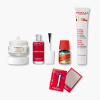
Mavala's Emery Boards are fine wooden boards with two sides of different grit, designed to match the delicate nature of the nail and suit all nail types. The two sides are the point: use the coarser side to take length off, then the finer side to smooth the edge you have just made. The Mini Emery Boards Pouch is the same idea in a handbag size, with two micro-grit sides suitable even for the most fragile nails, which is what you want for smoothing a snag before it becomes a tear.
One thing people rarely think about: files wear out. A board that has lost its bite makes you press harder and saw longer to get the same result, which is precisely the behaviour that damages nails. If you find yourself working at it, replace the board.
The habit to break: sawing back and forth
Almost everyone files by sawing in both directions, because it is quicker and it is what a nail file looks like it is for. It is also the habit most often blamed for a peeling free edge.
Filing in one direction is the standard dermatology recommendation. The American Academy of Dermatology advises pulling the file across the nail the same way each time, on the basis that filing back and forth can weaken nails, and Mavala's own guidance points at friction, since the sawing motion heats the layers of keratin. It is worth being straight that not everyone in nail science agrees direction is the decisive factor, and some argue grit and pressure do more of the work. What nobody disputes is that a coarse board and a heavy hand damage a natural nail, and sawing tends to encourage both. Work from the outside edge in towards the centre, lift the board away, and start again.
Hold the board flat against the edge rather than digging in underneath the nail. Filing up into the underside thins the free edge from below, and a thin free edge is a free edge that bends and splits.
File dry, not straight out of the bath
Nails absorb water, and a nail that has been soaking is softer and more flexible than a dry one. A softened nail gives under the board rather than filing cleanly, so it is easy to take off more than you meant to.
Worth pre-empting an apparent contradiction here: the NHS suggests trimming nails after a bath, when they are easier to cut. Cutting and filing are different actions. Leave shaping until the nail is dry. If you are doing a full manicure, shape the nails first, then soak and deal with the cuticles, then paint.
Choosing a shape that suits your nails
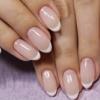
Mavala's own guidance is that the right shape is not the one that is in fashion, it is the one that harmonises with your fingers. Short, wide fingers are flattered by oval or almond, which lengthen the hand visually. Longer, narrower fingers carry square and squoval well. Beyond that it is a trade-off between looks and durability.
Oval. Usually the most forgiving on nails that break easily, because there are no corners to catch. It also makes shorter nails look longer.
Square. Keeps the most width across the tip, which tends to suit people who use their hands hard, though the corners are the part that catches. Softening them very slightly, sometimes called squoval, keeps most of the width and loses most of the snagging.
Almond and other tapered shapes. Elegant, but they are made by filing the sides in, which narrows the nail where it has least support. If your nails already break easily, a tapered shape is likely to make that worse.
Whatever shape you choose, keep all ten roughly the same length. One nail noticeably longer than the rest is the one that catches and goes, and then you are shortening the other nine to match anyway.
If they are already splitting
Better technique stops the damage getting worse, but it does not undo what is already there. Fingernails grow around 3 mm a month, so filing out a damaged edge is a matter of months rather than weeks. In the meantime, keep the length down so there is less nail to lever against, and treat the part that is actually failing. Mavala Scientifique K+ is made for brittle or splitting nails and fortifies the tip, the most delicate part of the nail and the part under most strain. Our guide to splitting and peeling nails goes into the causes in more detail.
If nails are catching and chipping while you wait for them to grow out, Nail Shield is a two-phase formula that forms a mechanical barrier against knocks, splits and chips. It is armour rather than a cure, which is exactly what you want while the damaged length grows off.
When a nail problem is not a filing problem
Filing technique explains a lot of everyday splitting and peeling. It does not explain everything. The NHS advises seeing a GP if a nail has changed shape, changed colour or fallen off and you do not know why, or if the skin around your nails has become sore, red, swollen and warm. It also suggests seeing a podiatrist if nails are too tough to cut or you cannot reach them. Full guidance is on the NHS page on nail problems. Nail care can make a healthy nail look and behave better. It is not a substitute for having a genuine problem checked.
Should I file my nails in one direction or back and forth?
One direction is the standard advice from dermatologists, who recommend pulling the file the same way each time rather than sawing back and forth. Not everyone in nail science agrees the direction itself is what matters, so use a light touch and a fine board too: pressure and grit count at least as much.
Is it better to file or cut your nails?
Either, as long as you finish by filing. Both the NHS and the American Academy of Dermatology are happy with clippers, and the NHS suggests trimming after a bath when nails are easier to cut. What a clipper leaves behind is a blunt edge that can catch, so smooth it with a fine board afterwards.
What grit of nail file should I use on natural nails?
A fine grit. Coarse boards are made for artificial nails and are too aggressive for a natural nail. A double-sided board lets you shape with the slightly coarser side and finish with the finer one. If a board feels rough under your thumb, it is too rough for your nails.
Should I file my nails before or after a bath?
File before, or well after. Nails absorb water and soften, and a softened nail gives under the board instead of filing cleanly. Note this differs from cutting: the NHS suggests trimming after a bath, when nails are easier to cut. Cuticles are easier to work with once softened too, so shape the nails first and deal with the cuticles after the soak.
Which nail shape is strongest?
Square keeps the most width across the tip, but its corners catch. Oval is usually the most forgiving overall because there are no corners to snag. Tapered shapes like almond look longer but are filed in at the sides, which removes support where a weak nail needs it most.
Shop online
The boards for shaping, and the treatments for nails that are already splitting.
Sources
Written and fact-checked by the Mavala UK e-commerce team. NHS, Nail problems (when a nail change is worth seeing a GP about). American Academy of Dermatology, tips for healthy nails (filing in one direction). The grit scale and the guidance on shaping to suit the hand are drawn from Mavala's own filing guide. Where the evidence on technique is contested, as it is on filing direction, we have said so rather than picked a side. Product details verified against Mavala's live UK product information, July 2026.
About Mavala UK
Mavala is a Swiss, family-owned care and beauty house, Swiss-made since 1959, and nail care is where it began. Its emery boards, base coats and nail treatments follow the same principle as this guide: how you look after a nail matters as much as what you put on it.