Looking After Your Nails During Cancer Treatment
Chemotherapy and other cancer drugs can change your nails: slower growth, ridges, lines, brittleness, sometimes a nail that lifts or comes away. None of it is your fault and most of it grows out. This is a plain guide to caring for them, built on what Macmillan Cancer Support, Breast Cancer Now and Cancer Research UK advise, with an honest note on where our own products fit and where they do not.

summary
In brief
We recommend a complete Swiss manicure: a base coat, then two thin coats of an opaque coloured polish, then a top coat, done the day before your treatment, renewed as soon as it wears, and kept up all the way through treatment and for a few weeks afterwards. Pick the base coat to suit the state of your nails. Skip glitter, and skip very bright shades if your nails are weak and porous. Take the colour off with an acetone free remover. Keep nails short but not too short, using a thin emery board rather than clippers. Moisturise nails and cuticles every day, and wear gloves for chores. No artificial, gel or resin nails, and no buffing.
Ask your oncologist or nurse before you start any of this, and stop anything that is not well tolerated. Tell your cancer doctor or nurse about any nail change, and ring the hospital straight away if the skin around a nail becomes sore and swollen. Any infection or inflammation needs treatment prescribed by a doctor.
What treatment does to nails
Cancer drug treatments can affect your nails. In Macmillan's words, they may grow more slowly or break more easily, you might notice ridges or white or dark lines across them, and sometimes nails can become loose or fall out. Breast Cancer Now adds that nails can become more brittle and cracked, that a nail which comes away will regrow, and that the risk of infection is higher during chemotherapy. None of this is caused by anything you did. Macmillan's full guide to skin and nail changes is the page to keep open.
Daily care that the charities recommend
Keep them short and smooth. Keep nails short, but not too short, and use a thin emery board rather than nail clippers or scissors. Hold the board at 45 degrees under the free edge of the nail and file from the side towards the centre, never back and forth. That is what stops nails breaking at the side and splitting. Do not use a nail buffer, it thins the nail and weakens it further.
Moisturise, every day. Macmillan says to moisturise regularly using a hand, foot and nail cream, and to massage a cuticle cream into the cuticles to help prevent dryness, splitting and hangnails. Do not cut your cuticles. Breast Cancer Now says the same in fewer words: use hand cream to help moisturise your hands, feet and nails.
Between manicures, we recommend Mava-Flex serum on the whole surface of bare nails once or twice a week, and then either Nailactan cream or Mavaderma oil massaged into the nail root every night before bed. Nailactan can go on over polish, though once a week it is better on bare nails, and it contains vitamin A, so take your daily intake into account. Mavaderma is the oil version, wheat germ, olive and sweet almond, to keep the skin around the nail soft.
Protect them. Wear gloves for washing up, household cleaning and gardening, to limit contact with water and detergents. Keep hands and nails clean with lukewarm water. If toenails are affected, wear comfortable shoes and avoid anything narrow, or a heel so high that your toenails push against the inside of the shoe. Do not bite your nails or your cuticles. All of this applies to toenails as well as fingernails. Some hospitals offer refrigerated mittens and socks during chemotherapy sessions to help protect the nails on hands and feet, so ask whether yours does.
Polish, false nails and remover: what the guidance actually says
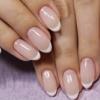
Start with our own position, because it is more definite than you might expect. We recommend a complete Swiss manicure, base coat, coloured polish and top coat, the day before your medical treatment, renewed as soon as it gets damaged, and kept going for the whole of your treatment and for a few weeks afterwards. In this context the polish is not decoration, it is a physical shield for the nail. These measures are widely applied and recognised in hospitals, but they are not yet scientifically recognised, so always take the advice of your oncologist or nurse before using any product, and stop straight away if something is not well tolerated.
The UK charities are more cautious, and their cautions still stand. Macmillan: wearing nail varnish is a good way to disguise nail changes, but if your nails are split, sore or damaged, do not use nail varnish or false nails. Breast Cancer Now: nail varnish tends to dry the nails out more. So if a nail is split or sore, leave it bare and cared for, and if you are not sure, ask your nurse. They will have been asked before.
On shade, the old rule has moved on. Dark shades, brown and black, were traditionally recommended in some oncology departments because they cover so well. A 2016 study by the Faculty of Pharmacy in Nantes found that opaque polishes applied in two coats are likely to give excellent protection against ultraviolet light even in lighter shades, so you do not have to wear black to be protected. Added UV filters do not appear to be necessary either, because the coverage of the polish itself does the work. What matters is that the shade is opaque and covering, and that you use two thin coats.
Two things to avoid. Glitter polishes, because they are hard to get off with an acetone free remover. And on nails that are particularly weak and porous, very bright shades, yellow, orange, blue and green, which can stain the nail.
False nails, gels and acrylics. We are clear about it: do not wear artificial, gel or resin nails, because they may encourage infection. That rules out permanent and semi-permanent polishes too, which need acetone to remove and involve buffing, and both of those thin the nail and weaken it further. Macmillan and Breast Cancer Now put it more softly, do not wear false nails, gels or acrylics during chemotherapy without talking to your team, because they can lead to infection or hide the signs of it.
The Swiss manicure, step by step
We set the Swiss manicure out in three steps, with an optional fourth, and name the products for each. Three aims run through all of it: protect, reinforce, moisturise.
1. One thin coat of base coat. This is the step that stops the pigments in coloured polish yellowing a porous nail, and it makes the manicure last. Which one you use depends on the state of your nails. Hydra-Base is for delicate, dry nails: provitamin B5, silk amino acids and a building block of keratin, in a water based formula that helps the actives get into the nail plate. It has to be followed by a polish or a top coat. 002 Base is for all nail types: fortified with organic silicon, and slightly tacky, which is what makes the manicure last so much longer. It also has to be followed by a polish or a top coat.
If your nails need physical cover rather than actives, we point you to the camouflage base coats, which carry mineral fillers. Mava-White for fragile, stained nails, an optical brightener that hides yellowing. Ridge Filler for fragile, ridged nails, which fills the surface and evens it out. Nail Shield for fragile, thin, ridged nails, a two phase product that builds a tough physical layer. All three can be worn on their own, and all three leave a neat finish without much shine, which suits men too. Nail Shield is prescribed by the Amiens University Hospital in France, in its onco-haematology and onco-gynaecology departments, after patients who applied it twice a week for several months showed an improvement in nail condition.
The base coats named above.
2. Two thin coats of an opaque coloured polish. We selected a set of particularly protective shades for exactly this, opaque, highly covering and enriched with organic silicon, sold as Mini Color's plus Silicium. Silicon in its organic form, silanols, tops up the silicon that is naturally present in the nail and helps strengthen it. That is silicon, not silicone, which does nothing for nails. If you would rather have a more natural formula, Mini Bio-Color's plus Silicium is made with at least 85 per cent natural origin ingredients, from sugar cane, rice, beetroot, wood pulp and corn, and you can spot them by the white cap. All the Mini Color's formulas are vegan.
3. One coat of top coat, for hold. Colorfix keeps the manicure flexible and more resistant to chipping. Gel Finish Top Coat gives volume and shine. Mavadry has a drying accelerator in it and leaves the polish touch dry in about a minute.
4. Optional. Whichever top coat you choose, Oil Seal Dryer goes on last. It makes the manicure touch dry straight away and its cotton oil nourishes the nail contour at the same time.
Top coats and the finishing oil.
Taking the polish off without drying the nail
Polish starts chipping after a few days, which is normal, and that is the point to take it off and redo it. Use a gentle acetone free remover. We make three: the Extra-Mild Pink Nail Polish Remover, which contains ingredients that reduce the harshness of the solvents, the Crystal Nail Polish Remover, which is gentle, non flammable and odourless, and the Nail Polish Remover Pads, gentle, non flammable and travel sized.
The three acetone free removers.
The technique matters as much as the product. Soak a cotton pad, press it firmly onto the nail and hold it there until the polish comes away, then take it off in one stroke. A second application may be needed for a dark shade or several coats. Do not rub, it stains the skin around the nail. Wash your hands thoroughly afterwards.
When to call your team
Tell your cancer doctor or specialist nurse if you notice changes to your nails; they can advise you or arrange a podiatrist for your feet. If the skin around a nail becomes sore and swollen, or shows redness, heat, swelling or pain, contact the hospital straight away on your 24-hour number. Do not wait for your next appointment.
Where our products fit, and where they do not
Mavala makes nail care and skincare. Our products care for nails and skin; they do not treat, prevent or cure anything, and nothing here replaces the advice of your care team. With that said plainly, these are the ones that match what the charities ask you to do, alongside the manicure products above.
Cuticle Oil. Sunflower, sweet almond and olive oils to nourish and soften the skin around the nail, made for daily use to help prevent dryness and torn cuticles. Massage it in; do not cut. This is the closest match to Macmillan's cuticle advice.
Prebiotic Hand Cream. Dermatologically tested and suitable for sensitive skin; Mavala describes it as strengthening the skin barrier while preserving its natural balance. Use it as the daily hand, foot and nail moisturiser the charities recommend.
Mava-Flex, Nailactan and Mavaderma. The three we recommend for moisturising and nourishing the nail itself: Mava-Flex on bare nails once or twice a week between manicures, then Nailactan cream or Mavaderma oil into the nail root nightly.
Emery Boards. For keeping nails short and smooth without clippers or scissors. Held at 45 degrees under the free edge, side to centre.
Extra-Mild Pink Nail Polish Remover, Crystal Nail Polish Remover and Nail Polish Remover Pads. All acetone free, which is what the charities ask for, and so do we.
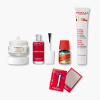
The daily care named above.
On nail colour itself, our own advice is clear: an opaque coloured polish in two thin coats, over a base coat and under a top coat, is the recommendation, not the exception. Hydra-Base is a water based base coat, which meets the charities' preference at that step, and it has to be followed by a polish or a top coat. The coloured polishes are conventional lacquers, as is Nail Shield. So the charity caution still applies at the top of the routine: if a nail is split or sore, leave it bare, and check with your care team before you start.
Shop Mavala
Everything named above, in one place.
Sources
Our own Mavala guidance (Mavala SA, Geneva) for all Mavala method and product advice. The study we cite: C. Couteau, E. Paparis and L. Coiffard, Comparaison de differents vernis a ongles en matiere d'efficacite photoprotectrice, Bulletin du Cancer, 2016.
Macmillan Cancer Support, Skin and nail changes from cancer treatment. Breast Cancer Now, Chemotherapy side effects. Cancer Research UK, Your skin, nails and cancer drugs. Product descriptions quoted from mavala.co.uk on 5 September 2026.