Nail Shapes: The Complete Guide to Choosing Yours | Mavala UK
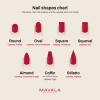
There are seven main nail shapes: round, oval, square, squoval, almond, coffin (also called ballerina) and stiletto. The right one for you depends on three things: the length of your fingers, the width of your nail bed, and how much maintenance your lifestyle will realistically allow. Mavala UK's nail expert Lynn Mason walks through every shape below, who each one suits, how to file it, and how to keep it strong.
summary
What are the main nail shapes?
A good shape is the foundation of every manicure. Polish, treatments and nail art all sit better on a well-chosen, well-filed shape, and the wrong one can make even the most beautiful colour look not quite right. Decades of Swiss nail expertise have taught Mavala that shape comes first, colour second.
How to choose your nail shape
Before you pick a shape because you have seen it on someone else, look at your own hands. Three things decide what will flatter you:
- Finger length: shorter fingers look longer with tapered shapes (oval, almond), which draw the eye along the nail. Longer fingers can carry blunter shapes (square, coffin) without looking shortened.
- Nail bed width: wide nail beds are balanced by shapes that narrow towards the tip: oval, almond or squoval. Narrow nail beds suit square and round shapes, which make the most of the width you have.
- Lifestyle and practicality: if you type all day, garden, or work with your hands, a shorter round, oval or squoval shape will survive the week. Long tapered shapes (almond, coffin, stiletto) concentrate pressure on a narrow tip and need length, strength and regular upkeep.
A simple rule of thumb: mirroring the shape of your cuticle usually gives the most natural, flattering result.
Lynn's note: "The question I am asked most is which shape is best, and the honest answer is the one your nails can actually hold. A beautifully kept squoval will always look better than a stiletto that keeps snapping."
Round nails
The most practical shape of all, and the natural starting point. Round nails follow the curve of the fingertip, with no corners to catch or snag.
- Who it suits: short nails, wide nail beds, and anyone who works with their hands. Round softens wide fingers and is the most forgiving shape for nails that are growing out or recovering from damage.
- How to file it: file from the side towards the centre, following the natural curve of your fingertip. Keep the length at or just beyond the fingertip.
- Maintenance: the lowest of any shape. Round nails resist breaking because there are no corners or points to take the impact.
Round is understated, so it pairs beautifully with brighter, bolder colours that do the talking.
Oval nails
Round's more elegant sister. Oval nails are filed into a gentle egg shape, tapering softly at the tip: a timeless silhouette that has never gone out of style.
- Who it suits: almost everyone, but especially wider nail beds and shorter fingers: the taper visibly lengthens the hand. This is the classic finger-flattering shape.
- How to file it: file the sidewalls at a slight inward angle, then round the tip into a smooth, symmetrical curve. Check the nail from underneath to make sure both sides match.
- Maintenance: low to moderate. Oval needs a little length to show its shape, but the soft taper keeps it strong.
If you are unsure where to start, start here.
Square nails
The classic manicure shape: a flat, straight free edge with crisp corners. Square is the shape of the traditional French manicure and suits a clean, architectural look.
- Who it suits: long fingers and narrow nail beds, which balance the blunt edge. On short, wide nails a true square can make fingers look shorter, so consider squoval instead.
- How to file it: file straight across the free edge, keeping the file parallel to the cuticle, then tidy the sides at a right angle. Leave the corners sharp but not jagged.
- Maintenance: moderate. The corners are the weak point: they catch on hair, knitwear and keyboards, so keep an emery board handy for quick tidy-ups.
Square nails carry deep, vampy shades particularly well: the straight edge gives a dark colour a beautifully graphic finish.
Squoval nails
Exactly what it sounds like: square meets oval. Squoval keeps the straight free edge of a square nail but softens the corners into gentle curves, removing the harsh edges while still elongating the finger.
- Who it suits: almost anyone: this is the great all-rounder. It flatters wide and narrow nail beds alike, works at short and medium lengths, and suits every polish shade you put on it.
- How to file it: file the free edge straight across as you would for a square, then take the file around each corner with two or three light strokes to round them off.
- Maintenance: low. With the fragile corners softened, squoval is one of the most durable shapes you can wear: ideal for busy hands.
If round feels too plain and square feels too sharp, squoval is your answer.
Almond nails
Elegant, feminine and endlessly flattering. Almond nails taper from the sidewalls into a soft, rounded peak, like the kernel of an almond, and create the illusion of long, slender fingers.
- Who it suits: shorter fingers and wider nail beds, which the taper visibly slims and lengthens. Almond needs some length beyond the fingertip to show its shape.
- How to file it: mark the centre of the free edge, then file each sidewall at an angle towards that point, finishing with a softly rounded (never sharp) tip. Symmetry is everything, so keep checking both sides.
- Maintenance: moderate to high. Filing into the sidewalls narrows the nail's stress point, so almond nails benefit from a strengthening treatment such as Scientifique K+ to keep the tapered tip from splitting.
Almond pairs beautifully with nudes, soft greys and muted tones: shades that let the shape itself be the statement.
Coffin (ballerina) nails
The shape of the moment for several years running. Coffin nails, also called ballerina nails, after the shape of a pointe shoe, taper like a stiletto but finish with a straight, squared-off tip.
- Who it suits: long nails and long fingers. Coffin needs real length to read as coffin rather than squoval, which is why it is so often worn on extensions or very strong natural nails.
- How to file it: file the sidewalls at an angle as if shaping an almond, then file the tip flat, straight across. The result is a slim, tapered nail with a blunt end.
- Maintenance: high. The tapered sidewalls plus squared corners create two stress points, so natural coffin nails need a hardener as a course, a protective base coat, and regular touch-up filing.
On natural nails, a shorter, softer coffin is far more wearable than the dramatic salon version, and considerably kinder to your nail plate.
Stiletto nails
The boldest shape of all. Stiletto nails taper sharply from the sidewalls to a dramatic point, and they are a statement before you have chosen a single colour.
- Who it suits: confident hands and committed owners. Stiletto demands length, strength and a lifestyle that allows for it: it is the catwalk shape, not the keyboard shape.
- How to file it: file each sidewall at a steep angle towards a centre point, keeping the strokes long and even. The point should be defined but not needle-sharp on a natural nail.
- Maintenance: the highest of any shape. All the pressure lands on one narrow point, so a strengthener such as Scientifique K+, applied as a course along the free edge, is essential rather than optional. Expect regular filing and the occasional repair.
Stiletto nails love attention: neons, statement shades and nail art all sit brilliantly on this shape.
Lynn's note: "Stiletto and coffin are gorgeous, but they are commitments. If a client wants the look without the breakages, I shape a short almond instead: you keep the elegant taper at a length real life can live with."
How to file your nails without weakening them
Whichever shape you choose, the filing technique matters as much as the shape itself. Done badly, filing is one of the quickest ways to cause splitting and peeling.
- File in one direction only, from the side towards the centre. Sawing back and forth creates heat and friction that tears the nail's keratin layers, leaving a ragged edge that snags and peels.
- Use a proper emery board, not a coarse metal file. Mavala's Emery Boards have two grades: the coarser side to set the length and shape, the finer side to seal and smooth the free edge.
- File when nails are dry. Wet nails are soft and bend under the file, which makes a clean edge impossible and encourages tearing.
- Finish by sealing the edge: a few light strokes with the fine side, angled slightly under the nail, closes the keratin layers and helps the shape last.
Five careful minutes once a week keeps any shape crisp: far better than one heavy reshaping once a month.
What are the different nail shapes?
The seven main nail shapes are round, oval, square, squoval, almond, coffin (ballerina) and stiletto. Round, oval and squoval are the practical, low-maintenance shapes; square is the classic manicure shape; almond, coffin and stiletto are tapered statement shapes that need more length and strength.
What nail shape is most popular in 2026?
Soft almond and short squoval lead the way in 2026: both flatter the hand while staying wearable day to day. Coffin remains popular for longer nails and special occasions. The wider trend is towards shorter, well-kept natural nails, which suits round, oval and squoval shapes beautifully.
What nail shape makes fingers look longer?
Tapered shapes lengthen the hand: almond is the most finger-flattering of all, followed by oval. Both narrow towards the tip, drawing the eye along the nail and creating the illusion of long, slender fingers. Pairing them with a nude shade close to your skin tone enhances the effect further.
What is the strongest natural nail shape?
Round and squoval are the strongest natural nail shapes. Round has no corners or points to take impact, and squoval softens the fragile corners of a square. Tapered shapes such as almond, coffin and stiletto file into the nail's sidewalls, which narrows its stress point and makes breaks more likely without a strengthening treatment.
What shape is best for short nails?
Round is the best shape for short nails: it follows the fingertip's natural curve, resists breaking and always looks tidy. Squoval is a close second if you prefer a straighter edge. Save almond, coffin and stiletto for when your nails have more length, as all three need a free edge to show their shape.
About Lynn Mason, Mavala UK Nail Expert
Lynn Mason is Mavala UK's resident nail expert. She has worked with the Mavala brand for over a decade, training nail technicians and beauty editors across the UK and writing Mavala's how-to guides.
Lynn's view: "Shape is the most underrated part of a manicure. People agonise over colour, but the shape is what makes a hand look elegant before any polish goes near it. Find the one your fingers and your lifestyle can carry, file it properly, and everything else gets easier."
Mavala Store
- Mavala Emery Boards: dual-grade boards for shaping and sealing the edge
- Manicure Rescue Kit: the essentials for shaping and caring for nails at home
- Scientifique K+: nail hardener for tapered shapes that need strength
- Mava-Strong: fortifying base coat to protect your shape between manicures
- Cuticle Oil: daily nourishment to keep the nail flexible and break-resistant