Why Is My Skin Dehydrated After Summer?
After a summer of sun, pool water and air conditioning, skin often ends up short of water, which is why it can feel tight and look dull by September. Dehydrated skin needs that water put back and held there, while skin that is properly dry needs oils as well, so the first job is working out which one you have.

summary
Put water back, then keep it in.
A hydrating serum under a light cream does most of the work. If your skin is also rough, flaky or itchy, it is short of oils too and wants a cream that replenishes oils as well. Go gently with exfoliation, and keep up the sunscreen: the NHS says the UK sun is strongest between 11am and 3pm from March to October.
What is the difference between dehydrated and dry skin?
Dehydrated skin is short of water. Dry skin is short of oils as well as water. So skin can be dehydrated without being dry, but very dry skin is dehydrated too.
Skin scientists can measure the two separately. In one published skin-type classification, skin counts as dehydrated on a reading of the water in its outer layer, and as oily on a separate reading of sebum (Seo et al., 2022). That is why a face that goes shiny by lunchtime can still feel tight.
The American Academy of Dermatology describes dryness in terms of both: harsh soaps can strip oils and fats from our skin, and when skin loses water too quickly, it becomes dry. Excessively dry skin, it says, has lost a lot of moisture, so it is noticeably dehydrated.
A dermatologists' position paper on dry skin recommends care with both rehydrating and lipid-replenishing components, and more lipid the drier the skin looks (Augustin et al., 2019). Water first, then oils. Our two skincare ranges divide the same way: Aqua Plus for dehydrated skin, Nutri-Elixir for dry skin.
Why does summer leave skin dehydrated?
The American Academy of Dermatology says you can still end up with dry, irritated skin in hot, humid weather, and names the sun, the pool and air conditioning as the biggest culprits. Lynn Mason, our in-house skin expert, put it the same way: "Excess sun exposure can be really drying on the skin, especially if you're in and out of the sea or pool." Long, hot showers to wash off sun cream, which the Academy also lists as drying, add to it.
How do I put water back into dehydrated skin?
Three steps, morning and evening. If you have just washed or showered, go straight on while skin is still slightly damp.
- Cleanse gently. Lynn's advice was to choose something gentle, because skin has already been through enough. Our Clean & Comfort Alpine Softness Micellar Water is fragrance-free and soap-free: apply to face, eyes and neck with a cotton pad, no rubbing, no rinsing.
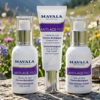
- A hydrating serum. We describe the Aqua Plus Intensive Serum as a moisturising intense serum that restores the skin's water balance. It is made with naturally derived hyaluronic acid in three molecular weights, Swiss Mallow flower and pure Alpine water, is fragrance-free, and goes on cleansed face and eye contour. It is made to layer under any cream, whatever your skin type.
- A light cream to hold it in. The Aqua Plus Featherlight Cream is specially formulated to provide 24 hours of non-stop hydration, a lightweight, melting cream for face and neck. Lynn's tip still stands: "apply the moisturiser while skin is still slightly damp, to really help seal in that moisture even more." The American Academy of Dermatology gives the reason: moisturiser works by trapping water in your skin. If skin feels very dehydrated, add a second layer once the first has absorbed.
Twice a week, add the Aqua Plus Snow Mask, a gel-to-oil emulsion that releases micro-droplets of water on contact with the skin, with a cooling feel. Apply generously to clean face, eye contour and neck, leave for 10 minutes, then remove the excess with a cotton pad. For evenings, the Aqua Plus Sleeping Mask is a hybrid cream-mask: a thin layer on cleansed face and neck, left on overnight.
What if my skin is dry, not just dehydrated?
Then it needs oils as well as water, which is what Nutri-Elixir is for. Both products are made for dry or mature skin, or skin lacking density.
The Nutri-Elixir Essential Serum is a concentrate of replenishing actives, including Swiss Linseed Oil, rich in omegas 3, 6 and 9. It is non-greasy, non-sticky and fragrance-free. Put a few drops on cleansed face, eye contour and neck, morning and/or evening, and when skin feels particularly uncomfortable, use a little extra with gentle circular massages.
The Nutri-Elixir Ultimate Cream follows it: a fusion of cream and oil, melting and lightweight, designed to reinforce the skin barrier. If your skin is tight and flaky at once, the Aqua Plus Intensive Serum can sit underneath it.
Where does make-up fit?
Let your cream absorb fully first. For coverage, Serum Foundation is our skincare-infused make-up: formulated with 83% skincare ingredients, with Vitamin C and natural prebiotics, in a lightweight, second-skin foundation with buildable coverage and a semi-matte finish. It is non-comedogenic and dermatologically tested. Blend a few drops from the centre of the face outwards with a brush, damp sponge or fingertips.
When to see a pharmacist or doctor
Skincare is for skin that feels tight or rough, not skin that is burnt. The NHS says a pharmacist can help with sunburn, and to ask for an urgent GP appointment or get help from NHS 111 if your skin is blistered or swollen after being in the sun. For dryness that carries on, the American Academy of Dermatology advises seeing a dermatologist if it continues after self-care, as it may be due to an underlying medical condition.
The rest of the after-summer routine
This is the third of our after-summer guides, following How Do I Fix Cracked Heels After Sandal Season? and Why Do My Legs Feel Heavy And Tired?. For dehydrated skin at any time of year, see Dehydrated Skin: How to Treat It.
Dehydrated or dry, how do I tell?
Dehydrated skin feels tight, especially after cleansing, and can look dull while still getting shiny later in the day. Dry skin goes further: a rough texture, flaking and itch are among the signs the American Academy of Dermatology lists for excessively dry skin. Tight but not flaky, start with water, using Aqua Plus. Rough and flaky as well, add oils, using Nutri-Elixir.
Can I still exfoliate?
Yes, gently. Lynn's post-sun routine used our Skin Vitality Beauty-Enhancing Micro-Peel, a creamy scrub with round exfoliating beads. Our directions are once or twice a week, in circular motions, avoiding the eyes and lips, then rinse; damp skin gives the gentler result. If you are still spending long periods in the sun, Lynn recommended once a week, "as you still want to keep that fine protective layer on the surface of your skin." Skip it while skin is peeling or sore: the NHS says not to try to remove peeling sunburnt skin, and the Micro-Peel is not for irritated or damaged skin.
What order do I apply things?
Thinnest to thickest: cleanse, serum, cream, then sunscreen last in the morning. Both our serums are made to be followed by a cream, and make-up goes on once the cream has absorbed. Our guide to skincare routine order covers every step.
Shop online
Water first, then oils if your skin needs them.
Sources
American Academy of Dermatology, 12 summer skin problems you can prevent (dry, irritated skin in summer; sun, pool and air conditioning; moisturiser traps water in skin).
American Academy of Dermatology, Dry skin: Who gets and causes.
American Academy of Dermatology, Dry skin: Signs and symptoms.
American Academy of Dermatology, Dermatologists' top tips for relieving dry skin (when to see a dermatologist).
Augustin M, Wilsmann-Theis D, Körber A, Kerscher M, Itschert G, Dippel M, Staubach P. Diagnosis and treatment of xerosis cutis - a position paper. Journal der Deutschen Dermatologischen Gesellschaft, 2019;17 Suppl 7:3-33.
Seo JI, Ham HI, Baek JH, Shin MK. An objective skin-type classification based on non-invasive biophysical parameters. Journal of the European Academy of Dermatology and Venereology, 2022;36(3):444-452.
NHS, Sunburn (self-care, pharmacist, when to get urgent help; page last reviewed 24 November 2025).
NHS, Sunscreen and sun safety (page last reviewed 24 March 2026).
Lynn Mason, 3-Step Post Sun Skincare Routine from Our Expert, Mavala UK blog, August 2022.
Product descriptions and directions quoted from our own product pages on 15 September 2026.
About Mavala UK
We are a Swiss, family-owned care and beauty house, Swiss-made since 1959. We have been making care for hands, nails, feet and legs for over sixty years, and everything we sell is made at Carouge, near Geneva.